This story was co-written with Maris in alternating sections.
I
The door to the living room had been kept shut for as long as anyone could remember. In fact, the door had been covered with a large wardrobe that hid it almost completely. It wasn’t too strange, as there were many rooms in this house that had not been used. For the last generations, any inhabitants in this house only needed access to the kitchen, a bedroom, and the bathroom.
Every now and then some young child would look at the house from the outside and notice a peculiar bay window that overlooked the darker part of the garden. They’d think to themselves in excitement that it would be a lovely place for reading books. They’d run inside, but within the activity of finding a book and starting to look for the room, they’d get lost in their excitement for something else that caught their eye while choosing a book. So they’d never get to realise that the reason they never found the room with the bay window is because its door had been blocked away and hidden from sight.
This room was never properly searched for, nor missed. It probably contained mundane things any living room would contain - there were no interesting tales to tell about why this room would be of any relevance or worth discovery. Generations of inhabitants had thought so, anyway. The house had recently received a new inhabitant - a young woman who had made it her mission to make the place feel like home for herself.
II
She was called Jane. She just finished her studies in antique furniture restoration and moved to the city to take her first job in the local museum. It was a poorly paid job in a medium-sized city somewhere in the countryside. The museum tried new communication strategies, trying to bring culture to younger people. However, the efforts were limited by the scarce subsidies from the culture ministry, the building long past its golden age, and the motivation to change the situation – it can be found in its entirety in an intern who tried to apply his graphical design skills to refresh the visual identity of the institution.
Jane was not naive, she knew where she would land and she enjoyed the perspective of a calm environment, leaving the capital where she studied. She liked her job, but it was not a passion as many would think. It was just a job she enjoyed, that’s it. She spends a lot of her time with her mind wandering. When she manipulates the wood and fabric from an old chair, her mind can roam free.
She had a few friends with whom she rarely talked about her past. She simply enjoyed the company of others, sharing moments not life. Every now and then, one of her friends would notice her picking wildflowers in a field, or on the side of a road. They would notice how great the flowers fit together, and start a conversation, meaning to ask her where she learned to craft such bouquets. But once they started to speak, they would forget their initial question and go about talking about something else, often ending up questioning Jane about her job.
III
Meanwhile at home, Jane’s landlord made it clear to her that she has full freedom to decorate the house as she pleases - there was no rule about having to keep the walls white and void of holes. In fact, the house was known to exhibit the many traces of the previous tenants. Although grateful for the freedom, Jane mainly just unpacked her things, placed them in the closets and shelves, and focused on keeping all the various items clean. The only element of herself that she added was keeping a fresh bouquet of flowers picked from the surrounding fields on her kitchen window.
Because of her easy-going nature and the friendliness of the town folk, Jane quickly made new connections. Out of the few colleagues she had at the museum, she became on good terms with Agnes - an elderly lady whose brain was like a complete archive of everything the museum had ever exhibited - except for if it had anything to do with farming - a topic that bored her deeply.
Agnes was putting together a program for the annual town birthday celebrations, due in the last week of April, and she was keen on getting Jane involved as a way to introduce the town’s history to her, as well as get her involved in the town’s life. Jane’s not big on celebrations, but a whole week of events that bring the town together via cafe days where people transform their backyards into cafes, as well as organising games on the town square, and concerts on the streets, sounded rather charming, so she agreed to volunteer her time towards the preparations.
IV
“We’ve known each other for a few months now, and I just realized I don’t know where you grew up!” Agnes exclaimed.
“Ho yeah, that’s right!” Jane replied with a slightly embarrassed laugh. She’s not used to people asking about her past so directly. “I come from a countryside house, in the north of England.”
It was the last week of April, and the two women were having coffee on a bench in Jane’s neighbor’s garden. It was the heart of the town’s anniversary celebrations, and the local community was bathed in a warm atmosphere. Everyone was hopping across gardens, walking barefoot in the fresh spring grass. Every house was open for anyone to make tea or coffee for the guests chatting outside.
While the two women were conversing, a young boy was playing in Jane’s garden. He noticed the bay window above him and thought this might be a great place to sit under a blanket to read a book. He wandered into the house, got very close to being distracted by an imposing lady carrying a tray full of sweet pastel de nata, and remembered what he was doing inside at the last minute. He looked around him, looking for the direction to get to the window. If he could trust his mental 3D model of the space, the bay window was on the other side of a large wardrobe that looked as if it were built with the house.
V
“That can’t be right,” the boy mutters to himself, confused. He walks around to the neighbouring rooms, trying to find alternative entrances, but on both sides, there are only walls, no signs of old doors or anything suspiciously entry-like. He returns to the wardrobe and starts exploring it more thoroughly. He looks at the sides - and he discovers it cannot be moved as it’s been built into the wall. He then tries to open it. The doors are old and heavy, he needs to put a lot of effort into pulling on the doors as the wood of the doors has expanded over time. At this point the boy is afraid of making noise and getting caught snooping around. But the doors seem to be moving slightly, so he tries to carefully apply as much force as he can - and one of the doors opens, with a startling creaking sound from the hinges. He quickly looks around - the coast seems clear, the lady with the pastel de nata is chatting away outside, but nobody seems alarmed by his activities.
He peers inside the wardrobe. It smells musty and like old wood, much like the antique exhibitions in the museum. There are a few shelves with old woollen sweaters on the side, a few old coats on the hangers, and a single men’s shoe on the bottom. The boy finds these disinteresting, and he is simultaneously disappointed to find that it’s not filled with old fur coats through which he could fall into the mysterious room on the other side. He suddenly hears someone opening the front door, and he jumps into the wardrobe and closes the door behind him - thinking it would be funny to jump out at someone.
As he is sitting in the wardrobe in the darkness, he can see a bit of light coming through the backside. He slides his fingers across the slit and realises that the back of the wardrobe isn’t just the wall as he had thought, it’s more like a piece of wallpaper that thinly covers the old entrance to the room. In his growing excitement, he starts expanding the slit in the wall with his fingers, and the paper moves away easily. But before he can peek through the hole he has made, he hears footsteps of a few people coming closer to his hiding spot, and moves his eyes towards the wardrobe door in anticipation.
VI
In the garden, the two women continued chatting cheerfully. Guided by her almost motherly curiosity, Agnes was slowly uncovering Jane’s origin story. She was gently guiding the conversation by recentering the topic without forcing it. She always allowed for an escape route while making space for Jane to talk about her life trajectory. It was like blowing on a ping pong ball to stay on top of a hill.
“And that’s how you chose to come here, in this village in the middle of nowhere, by picking flowers?” asked Agnes, interrogated.
“Yes, that’s how I’ve made the most important choices in my life. I go to a piece of nature I can find around me, start by touching grass while thinking about the choice I’m pondering. I then empty my head and wander around mindlessly by picking flowers on my way. When I come back home, I look at the bouquet. In the way the colors and shape fit together, I can always read the answer I was looking for.”
The women heard a cracking noise in the distance coming from inside the house. They marked a short pause, but it was not loud enough to capture their attention for long. Agnes used the short pause to gather her thoughts after this puzzling revelation.
“That’s such a beautiful way to make choices! I am glad the flowers made our paths cross, Jane,” replied Agnes. “I’ve never heard of such a custom before, where did you pick it up? – if I may say so, haha.”
Jane paused for a moment. She looked around and saw at the opposite side of their rectangular wooden table, a group of four neighbors caught in an intense card game. On the only other table present in the garden, a group of kids were enjoying pastel de nata and drinking hot chocolate while their parents were catching up over a cup of tea. Nobody was paying attention to them.
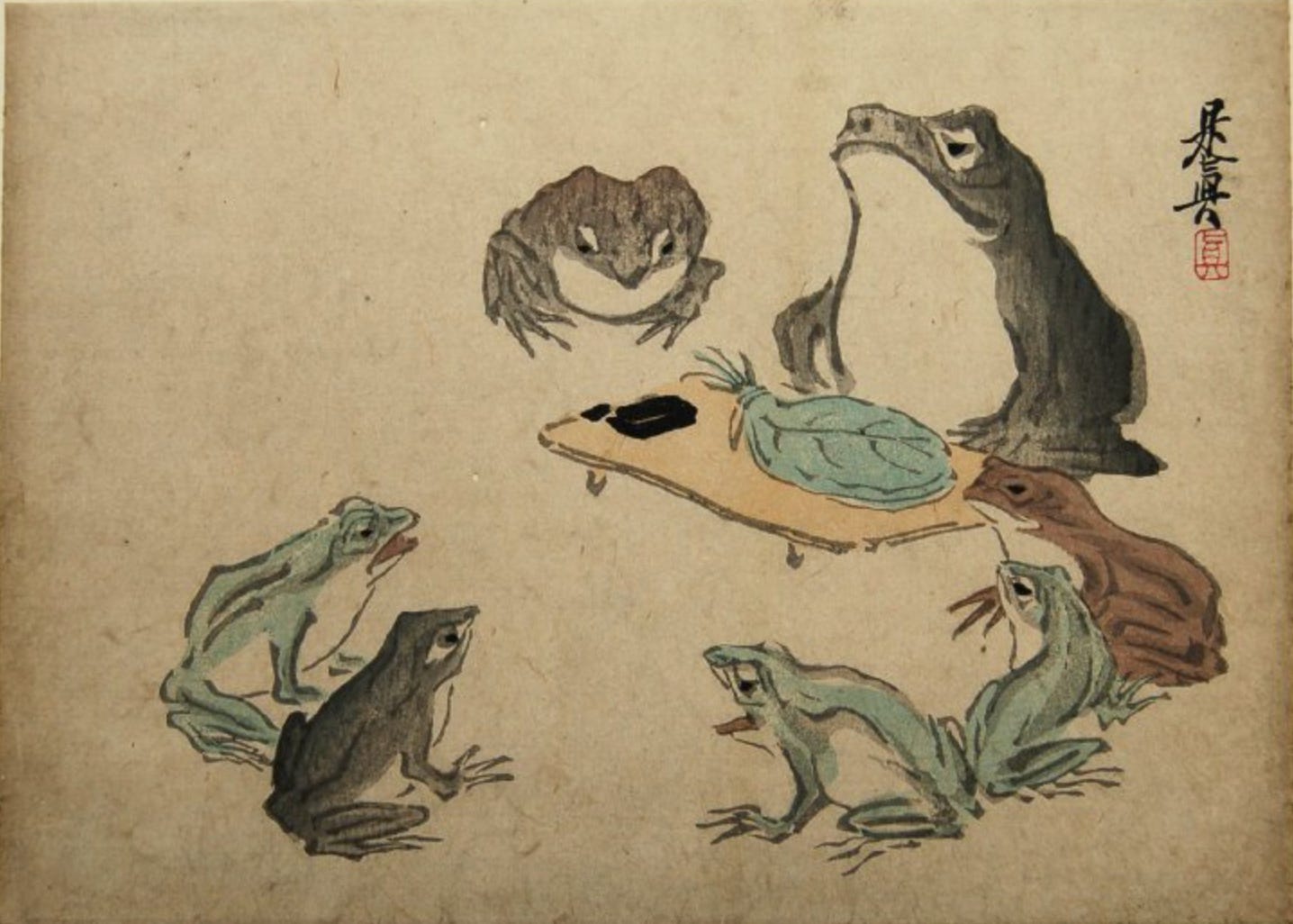
“This is where things might start to get weird,” said Jane with an embarrassed smile. But she felt safe in the conversation, and continued, “I was raised in a swamp, by a couple of frogs.”
VII
After Agnes’s initial confusion, Jane explains how, as a kid she spent most of her time in a swamp outside of her town. She was much closer to following nature’s rhythms than the people at her home - her parents and siblings were busy and loud people, Jane much preferred the loudness of frogs instead. She explained how she’d talk to them, observe their behaviors, and become quite good friends with some of them. They’d even start to greet her with a slightly different call that they used for other frogs - a call she mimicked whenever she went to see them.
But, over the span of her childhood, agricultural land demanded more and more of the vast swamp areas. They dried much of the land, such that there was no longer a peaceful yet lively solace with birds and frogs. Although this was hard at first, Jane was quite at peace with the doings of the farmers. But she did end up leaving her hometown and at the very least trying to find herself another peaceful dwelling elsewhere, where she would feel more at home.
Agnes listens intently, quietly, with a puzzled face, as if remembering something. “You know how the walls of the house have all been graced by the previous owners adding something?” she asks, almost unrelatedly, in the end. “Uhh, yeah?” Now it’s Jane’s time to be puzzled. “Well, your story about the frogs makes me think that there might be something you should see.” Jane raises her eyebrow, as Agnes rests her teacup on the table and stands up, awaiting Jane to join her on the way back into the house.
VIII
Agnes leads Jane to her bedroom and points at a painting above the bed. It’s an oil painting of a small frog sitting on a log in the middle of a swamp, looking back at you. “I found this when I was cleaning the house before your arrival,” Agnes says. “It was hidden behind another painting that was hanging over it. I thought it was quite nice so I kept it up, but I didn’t think much about it.”
Jane looks at the painting with wide eyes, and a smile starts to form on her face. She knows this frog, she can tell by its posture - it’s one of the frogs she used to talk to as a kid! But how could that be? How did it end up here? She’s overwhelmed by joy, and Agnes is not sure what to make of it.
“I know who painted this,” Jane says excitedly. “It must have been my great-grandmother!” She explains that her great-grandmother had also spent most of her time outside, observing nature and drawing what she saw. She would often paint frogs, and Jane remembers seeing some of those paintings in her childhood home. “But why is this painting here?” she asks herself out loud.
Agnes doesn’t know the answer to that question either. But she has an idea. “Maybe we should go check out that room behind the wardrobe,” she suggests with a mischievous grin.
They head towards the living room where they find the boy still hiding inside the wardrobe. He jumps out and runs away as soon as they enter the room, leaving them alone to investigate further. They push aside the large piece of furniture and discover an old door hidden behind it. The door is locked, but Jane finds a key hanging on a nail nearby and unlocks it.
As they step into the room, they are immediately struck by the smell of dampness and decay. The walls are covered in peeling wallpaper and mold, and there is a layer of dust covering everything. In the corner of the room, they spot an old easel with a half-finished painting on it.
Jane approaches the painting cautiously, recognizing her great-grandmother’s style immediately. It’s another portrait of a frog, but this one is unfinished - only the outline has been sketched in pencil.
“This must be what my great-grandmother was working on when she died,” Jane says quietly.
Agnes nods solemnly. “It seems like she never got to finish it.”
Jane looks around at all of the other paintings hanging on the walls - each one depicting a different scene from nature: trees swaying in the breeze, birds flying overhead, flowers blooming brightly against green grasses… And then she notices something else: every single one of these paintings features at least one frog somewhere within its composition!
“It’s almost as if…” Jane trails off, lost in thought for a moment before continuing: “…as if my great-grandmother knew somehow that someday someone would need these frogs again.”
Want to hear when I post something new?