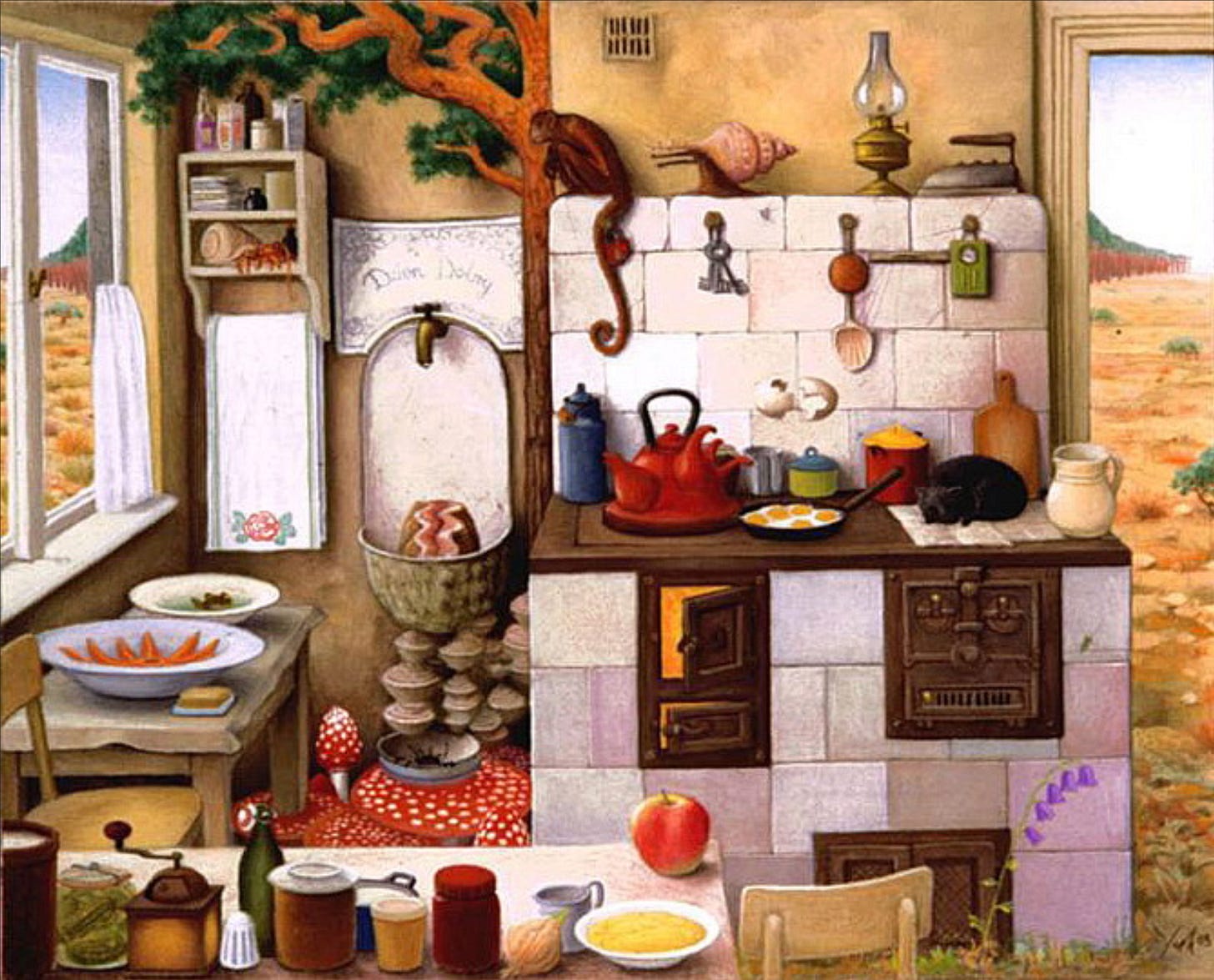
It is equipped with heat sources of various kinds, heat-resistant containers, a hob to evacuate toxic gas, instruments to manipulate reactive material adapted to different textures, measuring equipment, and, importantly, a stock of reactants, complex organic compounds that get restocked regularly and stored at cold temperatures to preserve their purity.
Over the course of a lifetime, we train to become better chemists. We get to discover surprising ingredient combinations. How weird it is that pears pair well with blue cheese! We learn the physics of heat when we have the great idea of adding water to a pan about to burn to stabilize its temperature at the point of ebullition. When making pizza dough, we interact with a practical application of polymer science. Through knitting and hydration, glutenin molecules bind to one another, forming chains in a molecular network.
The lab can also host biology experiments. When making a sourdough starter, we apply a selection pressure over weeks, sometimes years, to domesticate a diverse ecosystem of yeast and bacteria. The species adapts to the context in which they are raised: the humidity level, the flour, and the temperature of your kitchen. They become your best allies during baking: the yeast turns the sugar into bubbles of CO2 in your crumb, and the bacteria lower the pH by producing lactic and acetic acids, giving the bread its delicious sour taste.
The same room also works as an intermittent psychology lab. This is where we discover that other humans can have radically different subjective experiences of the same physical reality. “What? This delicious coriander taste like soap to you?” We learn that our tastes and values are not fixed, but evolve over time. We can even deliberately cultivate new tastes! The 10-year-old me would be very surprised to learn that I now enjoy drinking this bitter black liquid.
The result of this hard work is something very few scientific experiments can give you: good food, happiness, self-confidence in your ability to fulfil your needs, and importantly, a means of communicating love that goes beyond words. “I cooked the chocolate cake to keep the inside liquid, just like you like it. Have a bite.”
Want to hear when I post something new?