Over the past months, I worked with xiq to leverage the value of the Community Archive, a collection of 13M tweets gathered over the past 10 years.
Intuitively, this should not be that hard. The archive is filled with thousands of bangers scoring thousands of likes and retweets. Many of these gems are talking about intemporal topics like emotional integration and trauma release. Gosh! Even Aela’s viral Red pill / Blue pill poll was already in the best of 2023!
If these tweets were so popular when they were posted, surely they can still be helpful to people today?
But we kept running into the same problem: people don’t want to read old stuff.
You could curate the best gems from the archive, carefully picked for each user, but you’ll never be able to compete with the feeling you have when you refresh your X feed and watch the timeline of the world unfold before your eyes.
It seems dumb to detail why “fresh information is better than old”. It feels like a tautology. Of course, fresh info is the real stuff, the news that matters.
After many conversations on the topic, I am now (self-)convinced it is worth examining the forces behind the pull of fresh news, and I hope to convince you too!
Here are 4 mechanisms that make new content attractive, roughly ordered from strongest to weakest effect, and how they can be re-used to design interfaces with archives.
Fresh information is common knowledge.
News is supposed to be common knowledge. People are assumed to know the latest major events in their world, and conversation will often take them for granted, only vaguely referencing them. In turn, you can get deeper into topics as you know what’s fresh in your conversation partner’s mind.
Because of this collective norm, we are all very interested in staying up to date with our corner of the digital space so we can engage fully in conversation with our peers.
This phenomenon is not specific to new stuff. This also applies to content that keeps being referenced over long periods of time. It also applies to: a seminal paper from 1980 in a physics symposium, the Odyssey and ancient Greeks specialist, the AI Act and tech lawyers, this anime series that everyone born in the 90s knows about.
Reading is richer when you have the context.
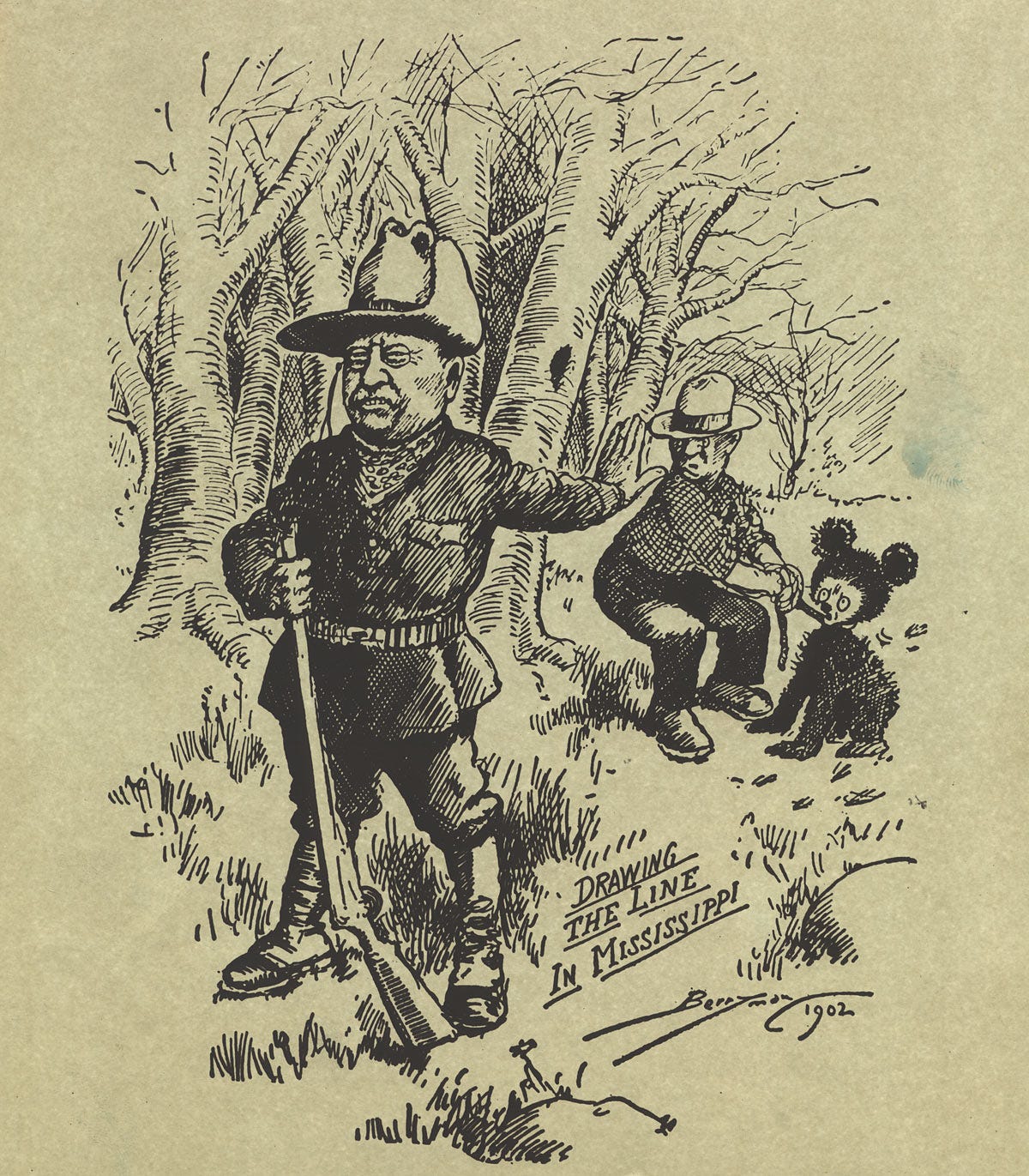
Do you get it? I’m sure many people laughed out loud back in 1902.
The guy with the gun is Theodore Roosevelt. He was invited on a hunting trip in Mississippi. The local hosts captured and attached a bear to a tree to be sure the president would have a catch, but Roosevelt refused to shoot it out of moral principle.
Aaaaaand around the same time, Roosevelt was mediating a state border dispute between Mississippi and Louisiana. You get it now? Drawing the moral line, drawing the state border line.
Yeah, once you dissect it, it loses its punch. Though it really was a hit at the time! The little bear in the cartoon became super popular, and people started selling stuffed versions of the character. It became Theodore’s bear, or “teddy bear” in short, that’s where the expression comes from.
This effect is a consequence of the previous point. When you can make assumptions about your reader’s state of mind, the whole timeline of events is a sort of conversation. Commenters make jokes, publish analysis, and follow up on events.
You get more bits per unit of time reading because you have the context. It’s like the text is more dense. For instance, you can estimate the significance of the events because what came up just before is fresh in your mind.
To make old information feel this way, you’d need to find a piece of the archive that you know the reader will directly be able to interpret. Like if someone was reading an in-depth biography of Roosevelt today, the cartoon might be funny to them.
In another register, you could show someone going through a romantic emotional rollercoaster the weirdly modern 1512 sonnet “I live I die” written by Louise Labé.[2]
Tomorrow will be like today.
The past two points have nothing to do with freshness per se. They are a consequence of many people paying attention to the same content, but the content doesn’t have to be new!
Now, here is a reason why news is special: world events tend to happen continuously, such that in the absence of a better model, what happens today is a pretty good approximation for what tomorrow will be like.
And our life, or our work, is sometimes impacted by the events we read about in the news. The fresher the news, the better we can calibrate our model of the future.
I expect this effect to be generally overblown for global news. The events feel so big that they surely should matter to us, but we are rarely impacted by what happens. It’s our attention system being hacked, as we’re not meant to watch at stages the size of the planet.
For this function, archives have a complementary role to play. Once you understand the situation you are in, the classic forecaster move is to look at how past similar events ended. To know if the MV Hondius Hantavirus outbreak will become a pandemic, look at how the 2018 birthday party outbreak ended: 34 cases and an easily contained spread.
The present contains the past.
I don’t need to read AI papers from the 1980s. Today’s AI techniques incorporated and expanded on the good stuff like neural networks and mostly forgot about the ineffective ecology of expert systems.
There might still be interesting ideas to be remixed, but I can safely expect most of them to be obsolete because the frontier has moved so much. In some sense, the current state of the art contains the past state of the art that produced it.
We can try to (too far): The same can be said of intellectual discourse as a whole. We are inspecting the arguments that survived thousands of years of intellectual debate. They are the frontiers of useful mental models or ethical reasoning. Studying the children’s ideas is enough to get the best of the parents who produced them.
This story is too extreme, of course, but there is something there. I often find myself reading old texts and thinking “how would this author react to this new scientific finding / modern counterargument”, e.g., “what would European phenomenologists think of the Buddhist canon?”.
A final riff on the same survivorship bias argument: if there was an important past reference you should know about, likely, today’s commenters would directly reference it. Most people don’t want to spend their time mining the past and sorting through tons of irrelevant context ‘just in case’.
Though, of course, our collective attention is fuzzy, and there is lots of merit to preserving a record we can go back to compare and directly quote.
Closing words
I don’t feel this decomposition fully gets to the juice of fresh news. I’m pretty happy about having identified some of the functions that fresh information plays by virtue of being a single flow of information everyone pays attention to.
Let me know if you see other mechanisms at play!
Thanks to Diego for feedback on a draft, and xiq for conversation on this topic.
Found using the great website searchartwith.art.
Original French version. Translation with Claude:
I live, I die; I burn and I drown,
I’m burning hot while enduring the cold;
Life is to me both too soft and too hard,
I have great sorrows shot through with joy.
All at once I laugh and I weep,
And in pleasure endure much grievous torment,
My happiness leaves, and yet lasts forever,
All at once I wither and turn green again.
So Love leads me on, inconstant,
And when I think I’m at my deepest pain,
Without noticing I find myself out of it.
Then, when I believe my joy is certain,
And that I’m at the peak of the bliss I longed for,
He drops me back into my first misery.
Want to hear when I post something new?